

How Much Power Does The Atomiswave Draw
The first Dreamcast emulator ever to become a Vulkan renderer. Completely open-source, written from scratch, and available afterward today on RetroArch. Update your core afterwards today to get the latest version with the Vulkan renderer! Available for Android, Windows, and Linux.
For more information, read down below…
Wait … a new what?
The renderer is the emulator component that emulates the Dreamcast/Naomi GPU fleck, namely the PowerVR Series2. It was i of the commencement generations of 3D chips, with merely a stock-still pipeline. The PowerVR2 supported DirectX 6.0, which was the graphics API used past Windows CE games on the Dreamcast. Successors of the PowerVR2 would later be plant in the original iPhone and iPod Touch (PowerVR4), iPhone 4 and iPad (PowerVR5) and many many other mobile devices. Now the Dreamcast GPU is more than twenty years old. You might think it should be easy to emulate such an aboriginal chip on mod hardware, correct? Well … yes for the most part. But there's i thing that the PVR2 does really well, and it'due south order-contained transparency. And even today this is all the same non picayune to implement even on mod hardware. You won't find this feature in Open GL or DirectX, and you need a pretty contempo version of these APIs to be able to emulate it, which means manually sorting individual pixels from back to front and blending them together, and doing this for each visible pixel on the screen!
OK, but what near Vulkan?
For those of y'all who are not familiar with Vulkan, it is a relatively new 3D graphics API, basically a follow-on to Open GL. Open GL is quite permissive and has little declarative constraints. You simply throw stuff at the driver when you need to and the driver'southward task is to effigy it out. The downside of this is that the Open GL driver frequently needs to guess what you'll do next and he might not gauge right. And when it doesn't, functioning suffers. Vulkan is radically unlike in that everything must be alleged in advance, in great details, and there'south very little room for improvisation on the part of the driver. Vulkan works much closer to the hardware than Open GL does. And so y'all can expect less overhead, more reliability and better functioning in many cases.
The downside of Vulkan is the sheer amount of code you have to write to brandish simply a unmarried triangle on the screen, let solitary a full-featured Dreamcast renderer. Last time I checked, the Vulkan renderer had 47 source files and around 7800 lines of lawmaking. (The Open GL renderer only has around 6000 lines of code.)
Then what do we go?
As with Open GL, at that place are actually two Vulkan renderers: The first one uses a traditional single render pass with per-triangle or per-mesh sorting done past the CPU. The 2d one is capable of order-independent transparency with per-pixel sorting performed past the GPU. It uses multiple subpasses to compose the concluding prototype: the beginning subpass draws the opaque geometry depth map and the shadows casted on them. The 2d subpass renders all opaque geometry to a temporary colour framebuffer, and transparent geometry into a huge pixel linked list. The last subpass then renders shadow volumes for translucent geometry. And finally all pixels are sorted and blended together using the opaque framebuffer of the previous subpass as background.
The next Flycast nightly build will have support for Vulkan on all major platforms: Windows, Linux and Android. In terms of features, the new renderer should be on par with the Open GL renderer, with the notable exception of lightgun crosshair and VMU screens display, which will be added before long. All the same, expect to observe bugs and crashes here and there as is expected with whatever new piece of software. Also information technology may exist slower than Open GL depending on many factors such as GPU, commuter version, game existence played, etc. We'll do our best to prepare any effect encountered and overcome operation issues. When reporting problems, brand certain to indicate what GPU yous're using and the Vulkan driver version. It is highly recommended to upgrade your drivers to the latest version bachelor, especially on mobile.
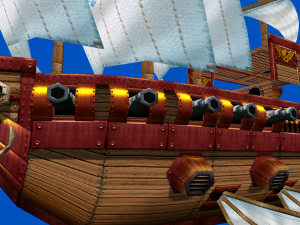
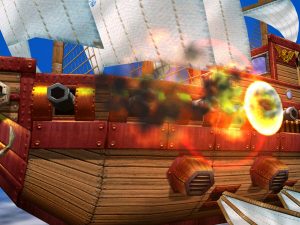
Here is a showcase of the differences betwixt the basic and OIT renderers. By the mode, this as well applies to Open GL.
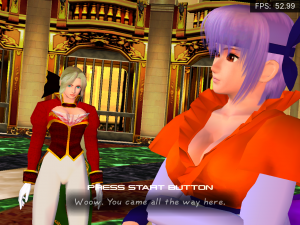
Here the hair of these ladies bear witness glitching triangles in basic style.
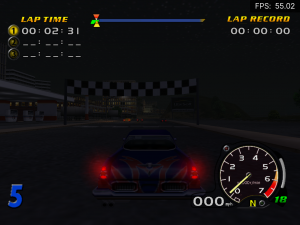
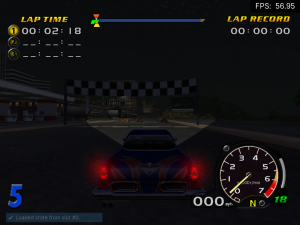
In Speed Devils ii, the shadow volumes (called "Modifier Volumes" in Dreamcast literature) are used in a special style to project headlights. This is only possible by using deferred rendering.
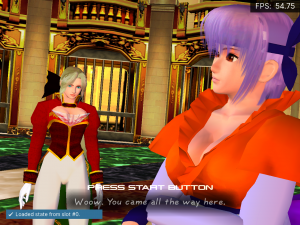
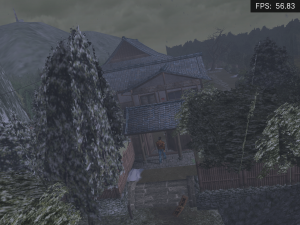
In this instance, look at Ryo'south cast shadow on his left. At that place is a fog result practical to this scene, but the basic unmarried pass renderer cannot employ a fog upshot to the bandage shadow. In the OIT renderer, the shadow is perfectly fogged.
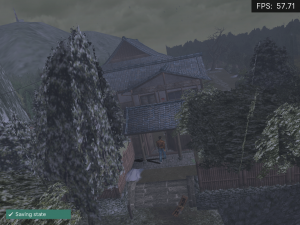
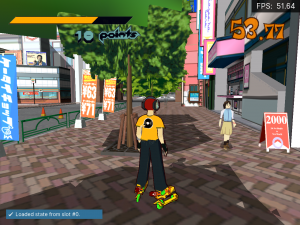
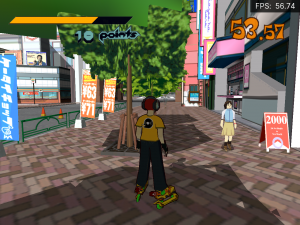
In Jet Set Radio, the character is composed of translucent polygons, and these polygons can be shadowed too. Merely the OIT renderer tin properly render shadows cast on translucent polygons.
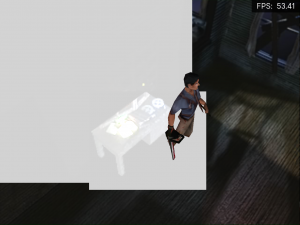
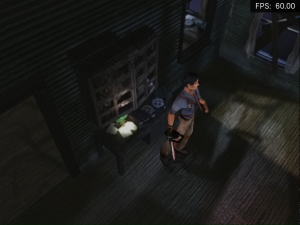
To finish, here is another seldom used GPU features: secondary accumulation buffer. It can be used to do tri-linear filtering and other effects. This is Evil Dead – Hail to the King and it is clear that the basic renderer is having a difficult time hither.
Final thoughts
Aye, the per-pixel blastoff transparency pick which to this appointment was only available on Windows and Linux now too works on Android with the Vulkan renderer. However, keep in heed that per-pixel alpha sorting is heavily memory bandwidth-limited. It has been tested on a Mali G76 (Samsung Galaxy S10+) – and it runs passably at 640×480 or 800×600 resolution. Your mileage may vary depending on the GPU ability inside your Android telephone. Nosotros recommend y'all to find that sweet spot which works all-time for you, and if results are too bad with per-pixel blastoff enabled, turn dorsum to per-triangle.
Some clear advantages of the Vulkan renderer is that frame pacing is much ameliorate than the OpenGL renderer, and operation is far higher when information technology comes to texture uploads and/or framebuffer manipulation. For example – when you KO an opponent in Dead Or Alive 2 against an explosive wall – the framerate would often tumble a bit on GL, but no such bug with Vulkan. Similar improvements tin be noticed in Virtua Tennis 2 – when certain framebuffer effects happen after a replay, performance is much more steady with Vulkan thanks to the loftier degree of parallelism.
With Vulkan, nosotros have heard reports that virtually all sound crackles and stutters are gone. That'southward because with vulkan you lot choose the sync points where you wait. In GL the commuter has to guess and sometimes it fails. These effects are using return to texture, and with OpenGL this creates sync issues.
It's been a pretty decorated end of the year for the BeetleDC core. Most of the work consisted in finalizing and improving support for Naomi and Atomiswave arcade ROMs.
Naomi / Atomiswave
Naomi GD-ROMs are at present supported and this adds more than 120 Naomi games to the list of supported arcade games.
ROMs archived with 7zip every bit well as parent/split ROMs are at present supported too.
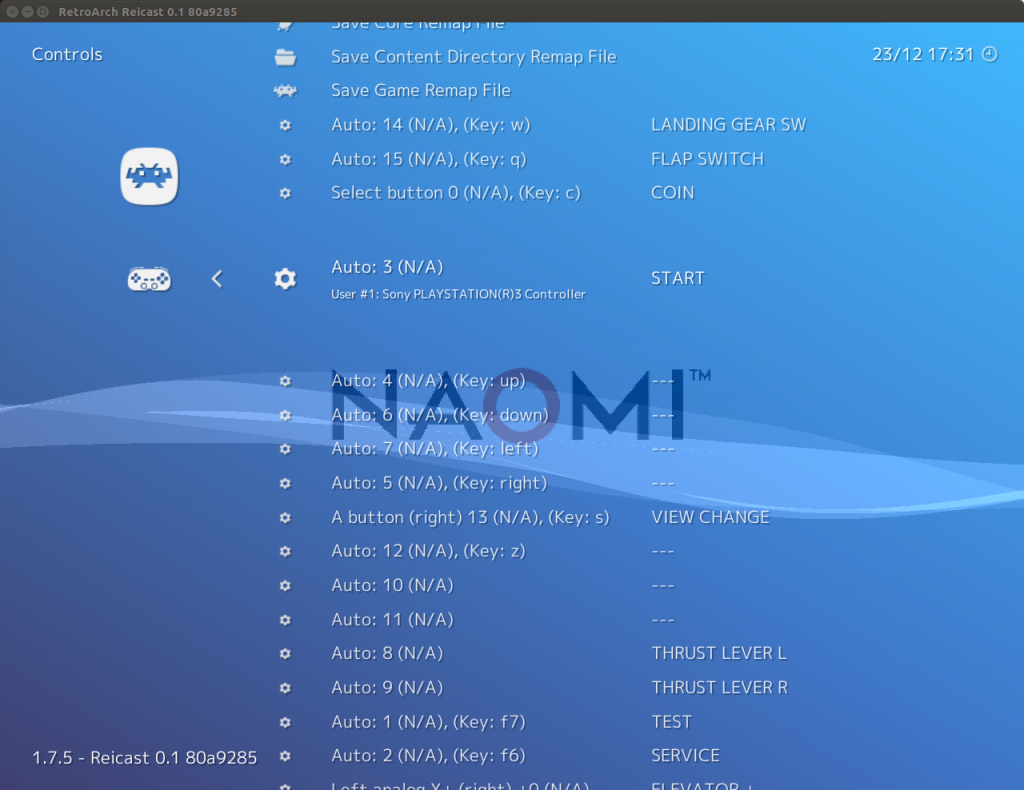
Another new feature is the apply of per-game input descriptors: and so instead of binding "Button i" or "Axis 1", you'll take descriptive names such equally "JUMP" or "STEERING WHEEL". Non all games accept input descriptors but more volition be added in the future (and pull requests are welcome.)
In addition, many bugs have been stock-still allowing many arcade games to now be fully playable: 18 Wheeler, Airline Airplane pilot, Cosmic Nail, House of the Dead ii, Jambo Safari, Ninja Assault, Shooting Love, Virtual Athlete, Virtual On Oratorio Tangram and probably more.
Dreamcast
On the Dreamcast forepart, a recent but notable improvement is the automated setting of the BIOS appointment and time at boot. And then you should never see the date/fourth dimension setting screen again. In the same area, a new cadre option allows to choose the BIOS language, so you don't have to kick the BIOS to alter information technology.
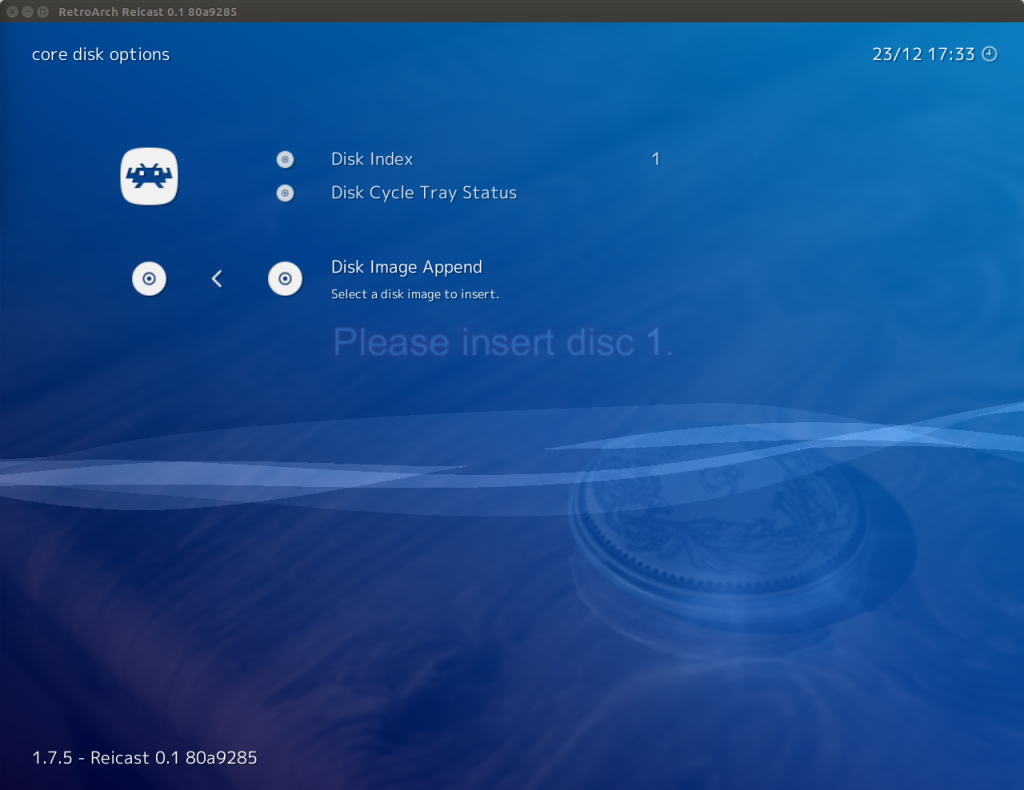
Using the Libretro deejay control interface, disk swapping has been implemented. When asked past the game, you can now virtually squirt the electric current disk and select a new ane without restarting. Some multi-disk games require this feature such every bit D2 or Popular'north Music 3 and iv append disks.
Another new feature for both console and arcade is the Synchronous Rendering core choice. This option is only active with Threaded Rendering. When activated, it will pause the emulation thread instead of dropping a frame, which results in less dropped frames and thus a better and smoother frame rate.
Finally, Restart has been implemented then one can reset a game without having to restart the front-end.
Happy and Peaceful Holidays!

How Much Power Does The Atomiswave Draw,
Source: https://www.libretro.com/index.php/category/atomiswave/
Posted by: roybaltagning.blogspot.com
0 Response to "How Much Power Does The Atomiswave Draw"
Post a Comment